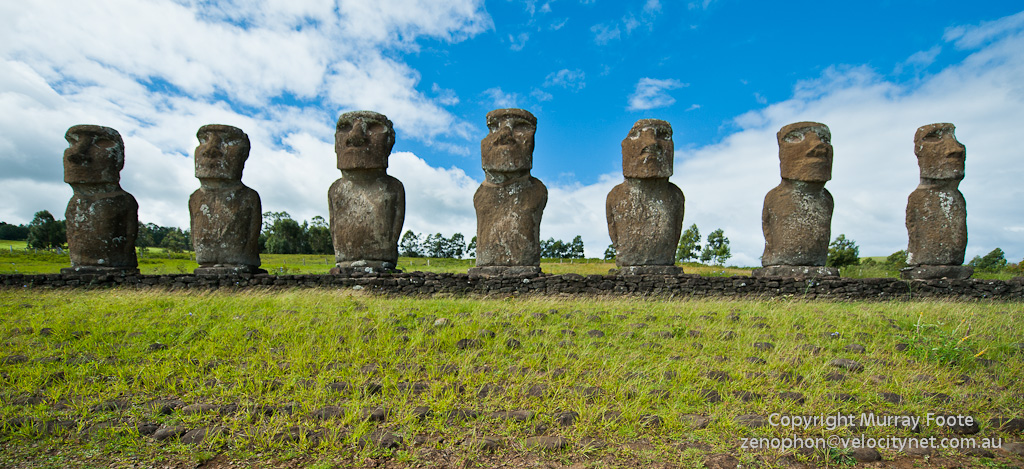
Ahu Akivi
Ahu Akivi was the first ahu to be restored, by William Mulloy in 1960. It is 33 metres long and inland, north of Hanga Roa. It contradicts the often expressed view that all ahu are on the coast and face inland. This is simply because they typically face the village of their associated tribe or sub-tribe.

Ahu Akivi
Moving the moai here would have been a significant task because the ahu is nearly 15km from Ranu Raraku and the moai weigh up to 13 tonnes.

Ahu Vai Teka
Quite close to Ahu Akivi is the much smaller Ahu Vai Teka with a single small eroded moai torso. William Molloy restored this ahu at the same time as Ahu Akivi. This appears to be the frontal view. We are looking south to Hanga Roa with our backs to the road.
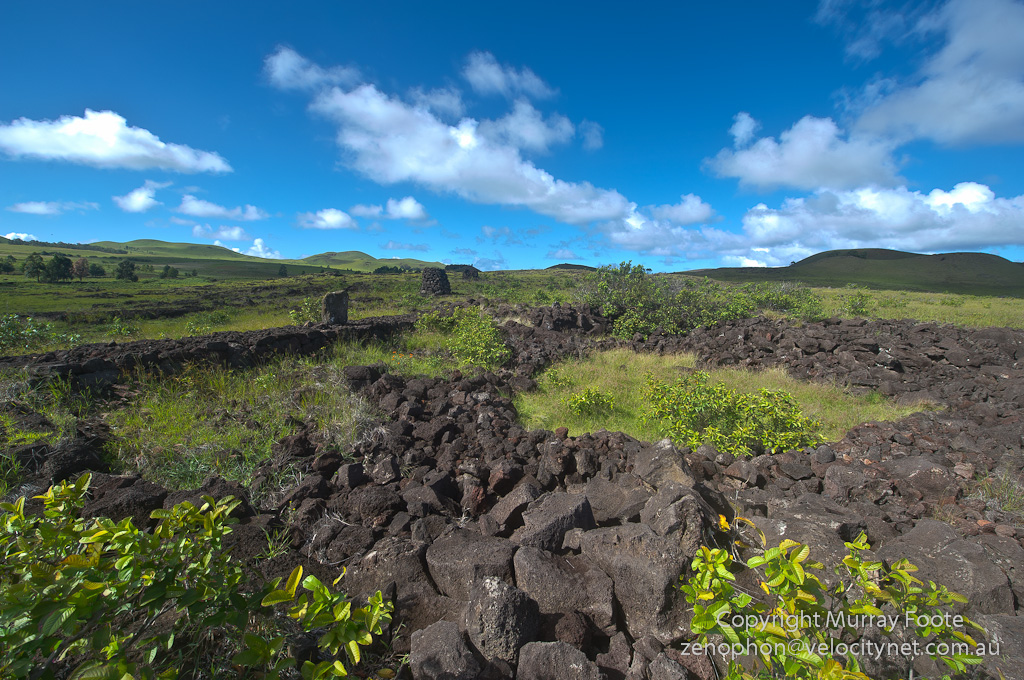
Ahu Vai Teka
This is the view from the back, looking towards the centre of the island. The green circle on the right is probably a manavai (an area for growing plants protected by a stone wall). To the left of that is the ahu and the moai. Behind and to the right of the moai are a couple of pipi horeka (boundary markers or possible observation platforms).
 Murray Foote
Pingback: 26th April: Easter Island (Vinapu) | Murray Foote
Pingback: Easter Island Wrapup and Contents | Murray Foote
Pingback: Itinerary of Journey to Patagonia, Antarctica and Easter Island | Murray Foote