Kyoto is a city of around 1.5 million people and is not far from Osaka, a very large city. There are many charming side streets with elegant houses and exquisite trees but this is not what we have here, instead, one of the many cyclists and a curious version of the corner liquor store. At this time I am walking towards Kinkaku-Ji (the Golden Pavilion).
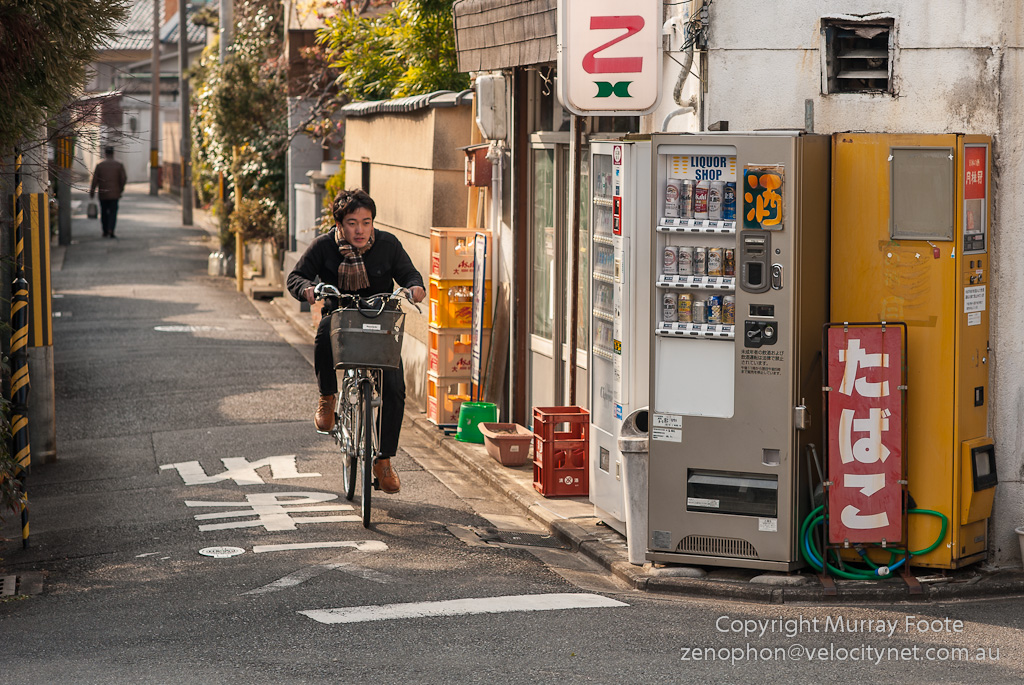
Taken while on foot, en route to the Golden Pavilion
And this is Kinkaku-Ji.
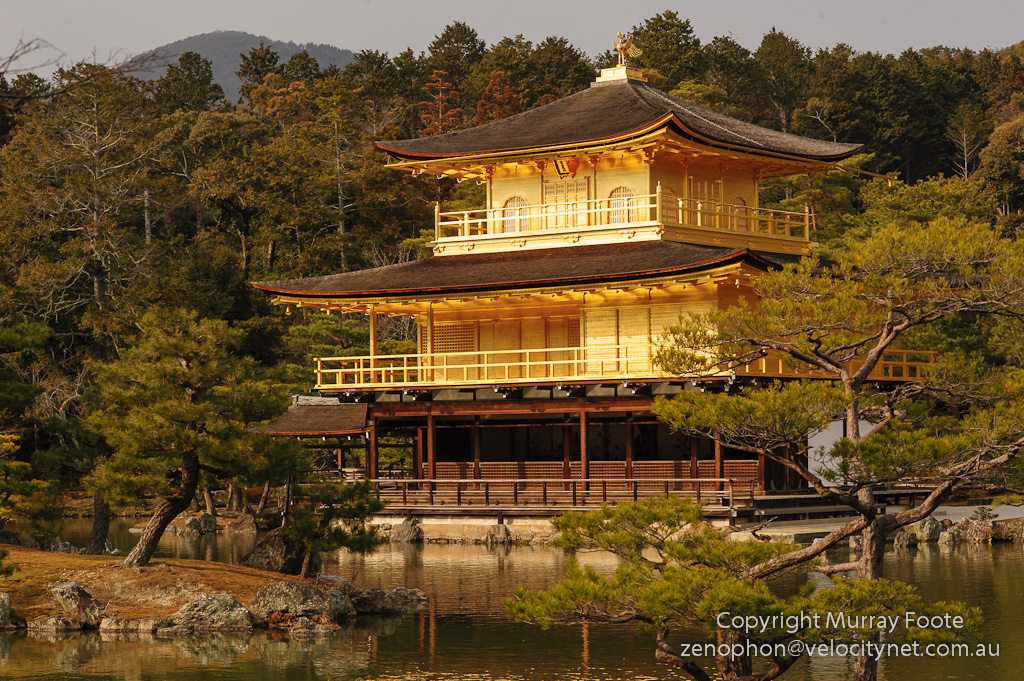
The Golden Pavilion
The shogun Ashikaga Yoshimitsu built Kinkaku-Ji (also called Rokuon-Ji) in late fourteenth and early fifteenth centuries as his retirement villa and covered the top two stories in gold leaf. There were also many other buildings at the time that have not survived. Kinkaku-Ji itself was burned down in 1950 by a renegade monk and later rebuilt. The burning of the pavilion was the subject of a Mishima novel The Temple of the Golden Pavilion.
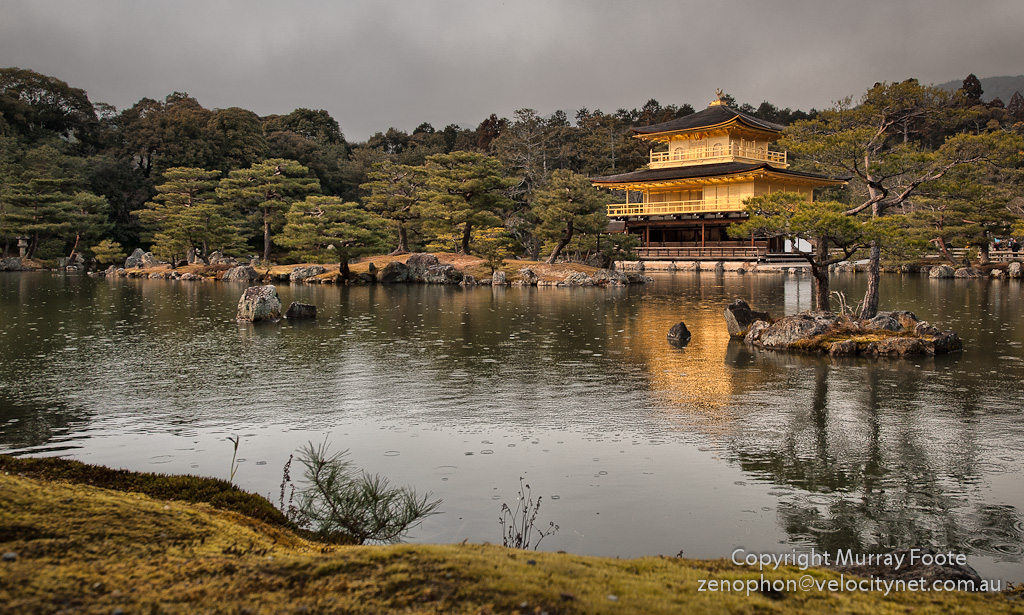
Golden Pavilion and Lake, with rain falling
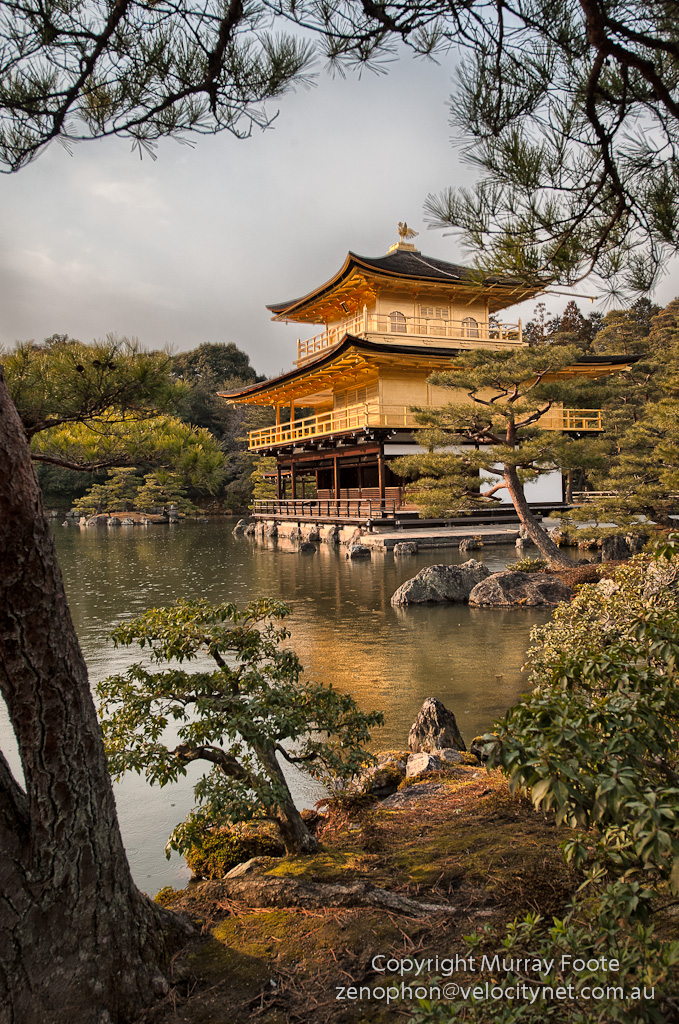
Golden Pavilion
Yoshimitsu was the most successful of the Ashikaga shoguns. Though he handed the shogunate to his son in 1394, he was effectively shogun from 1368 to 1408. Since his grandfather staged a coup against the Emperor there had been two royal courts and intermittent civil war. Yoshimitsu saw the Southern Court (arguably the legitimate imperial line) submit to the Northern Court under the control of the Ashikaga dynasty.
Notwithstanding the frequent conflict in this period, it also saw a cultural and artistic flowering that permanently changed Japanese aesthetics. There were several factors that fostered this: freedom from the set ideologies of classical Japan, renewed aristocratic influence due to the return of government to Kyoto from Kamakura, widespread improvements in artisan skills due to breakdown of class roles and decentralisation, and the influence of newer more egalitarian religions such as Zen.
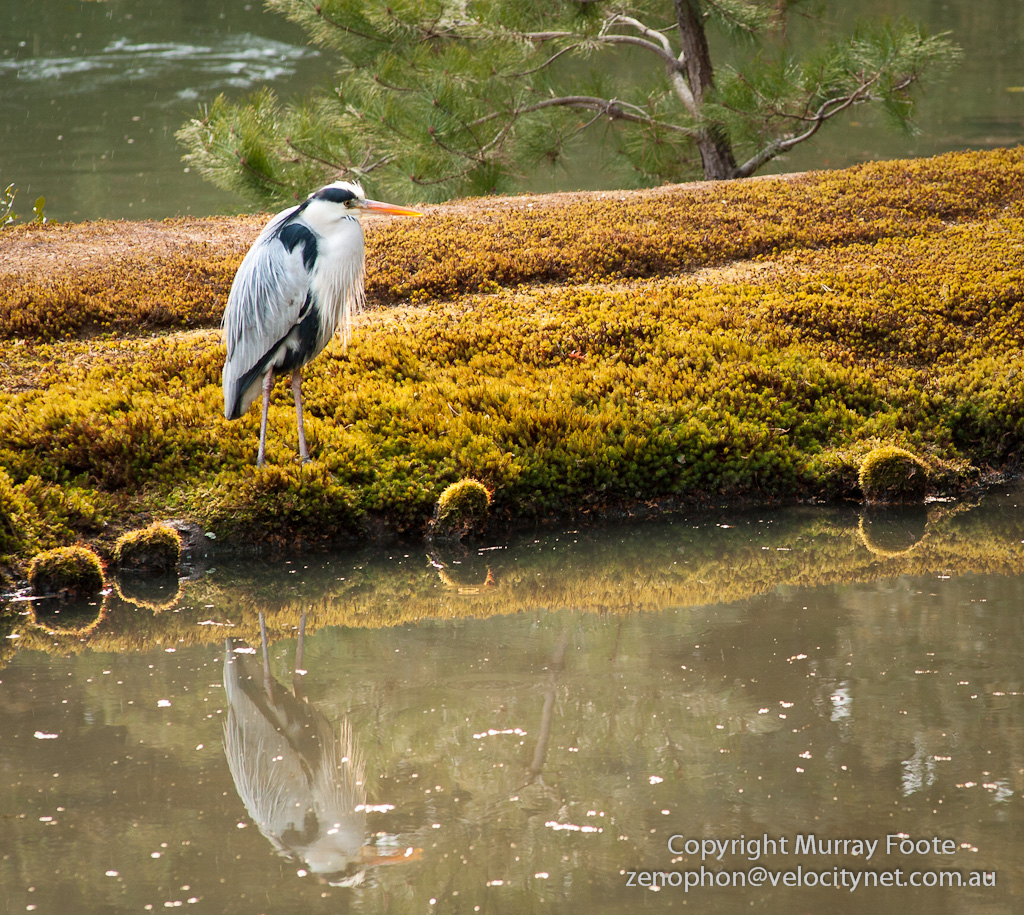
A heron beside a nearby pond

Reflections of the Golden Pavilion in the Lake
Ashikaga Period (1336-1573)
In 1333, the emperor Go-Daigo challenged the power of the Kamakura shogun. The shogun charged Ashikaga Takauji with defeating the imperial forces but he changed sides and defeated the shogun. After a brief period where the Emperor had full political control, Ashikaga Takauji took effective control and founded the Ashikaga shogunate.
The Ashikaga shogunate was weaker than the Kamakura bakufu had been or the Tokugawa shogunate would become. The feudal system of obligations was less tightly bound and many daimyo had little more than nominal allegiance to the shogun. The old system of moral behaviour was breaking down and individual daimyo became more inclined to go to war for their perceived personal gain, unfettered by a sense of any obligations.
The latter part of the Ashikaga period was the Sengoku or Warring States period. This started in the Onin War or 1467 to 1477 where there was a civil war between two clans in and around Kyoto and with battle lines inside Kyoto. It centred on a dispute over who was to be the successor of the shogun, even though the shogunate was not vacant. There was then a period of continuous local warfare until 1600. Paradoxically, this was not all bad. The decline of central control led to more widespread and localised skills, economic development, artistic achievement and literacy.
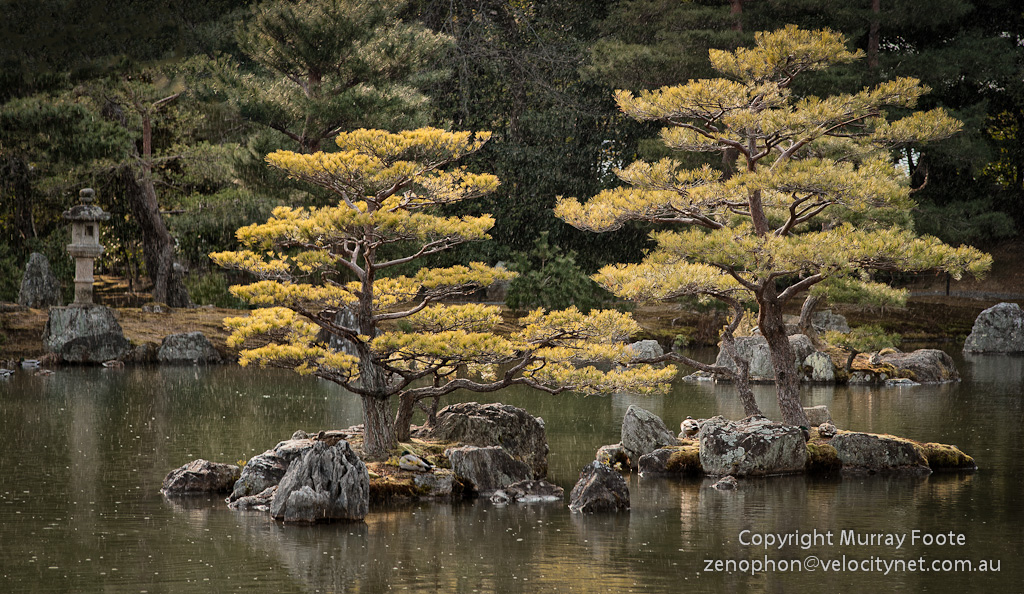
Trees on tiny islands in the lake
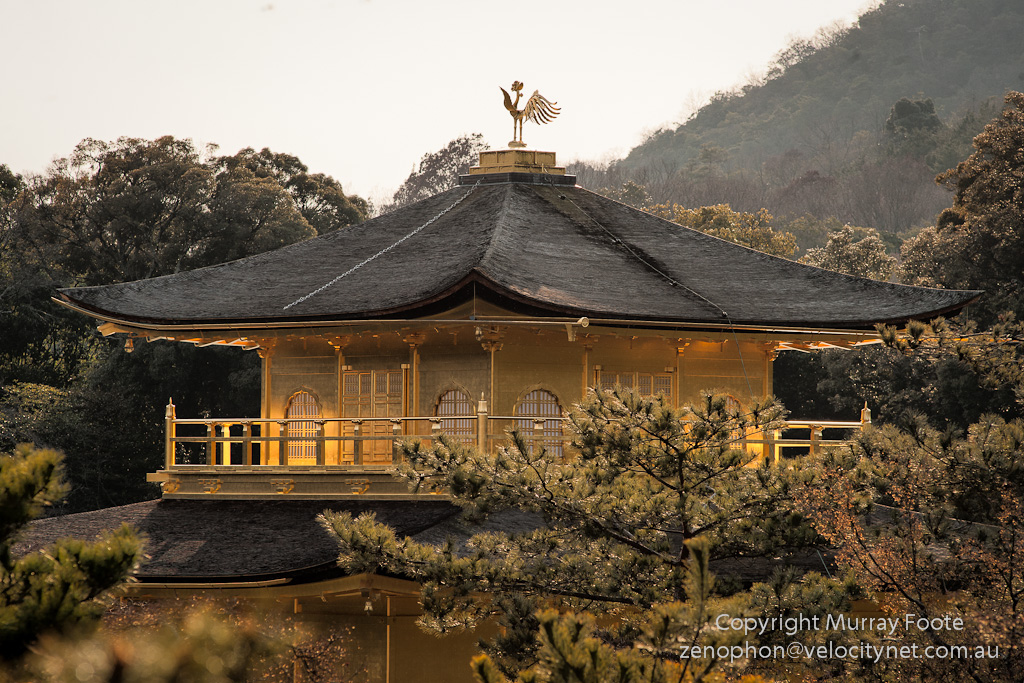
The top of the Golden Pavilion from the hills behind, now in persistent rain.
Main Periods of Japanese History
- Early Periods
- From early hunter-gatherers to the beginnings of Imperial Japan in the Ise Peninsula
- Nara 710-794
- First fixed capital. Highly centralised system with strong Buddhist influences.
- Heian 794-1185
- Capital moves to Heian-kyo (now Kyoto) with Fujiwara clan having main power. Centralised power system slowly dissipates.
- Kamakura 1185-1333
- Minimoto Yoritomo seizes effective political power and established a “tent capital” at Kamakura, south of Tokyo (then Edo). Mongol invasions repulsed.
- Ashikaga 1336-1573
- Power supposedly returns to Kyoto under the Ashikaga shoguns but local daimyos become much more powerful and conflict becomes endemic
- Momoyama 1565-1615
- Oda Nobunaga, Toyomoti Hideyoshi and Tokugawa Ieyasu (leaders in succession) take effective control over Japan and end the Warring States period. Attempted conquest of Korea and China in 1590s fails.
- Tokugawa 1603-1868
- A long period of stability, most of it in isolation from the West.
- Meiji Restoration and Modern Period 1868-present
 Murray Foote
Pingback: Itinerary of Journey to Japan | Murray Foote
Pingback: Updates | Murray Foote
The Golden Pavilion looks stunning with the water in front of it. Beautiful!
LikeLike
I was lucky that I arrived there in late afternoon.
LikeLike
Pingback: 29th January: Kyoto – The Philosopher’s Path – Ginkakuji (The Silver Pavilion) | Murray Foote
Pingback: 25th February: Kamakura – Diabutsu | Murray Foote
I envy you this trip 🙂
LikeLike
You’ll probably get there sooner or later if you really want to. Japan’s a great place to visit, friendly and safe and amazing places to visit. And staying in the ryokan is definitely the way to go.
LikeLike