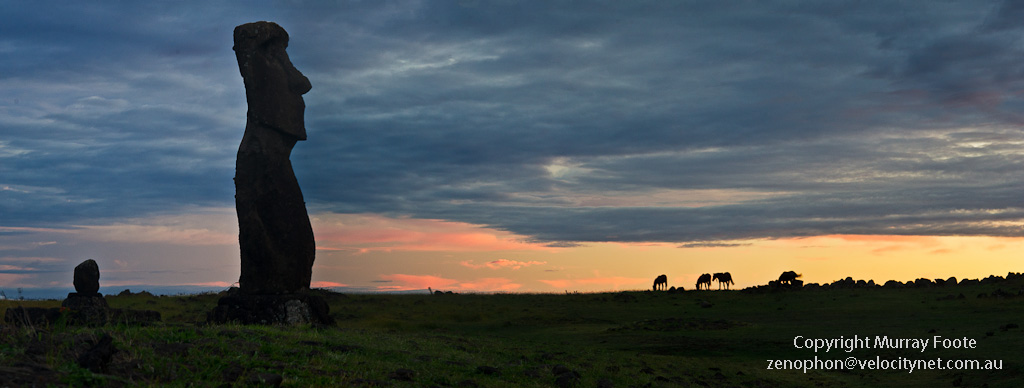
Ahu Hanga Kio'e
We arrived at Ahu Hanga Kio’e before dawn, with only a few horses for company.
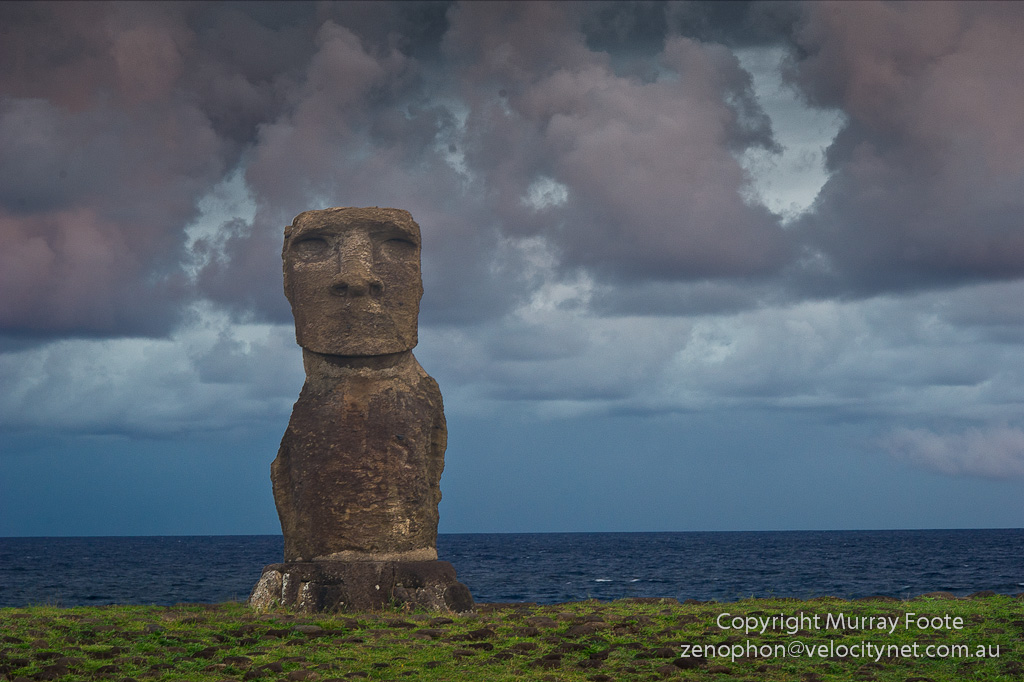
Ahu Hanga Kio'e
This is reputedly the last ahu built, in the mid 1600s. The moai is in reasonably good repair and appears to have eye sockets so presumably the ivi atua (priests) would have inserted eyes on special occasions.

Ahu Hanga Kio'e
There is also a second, smaller ahu here with a fragment of a moai. I haven’t featured it here but the rounded bump on the far right skyline is that moai fragment.

Ahu Hanga Kio'e
Moai contemplating the dawn.
Ahu Hanga Kio’e means ahu on Kio’e Bay and kio’e is rat so it’s the ahu on rat bay. To us that might sound like noxious rodent ahu but the Rapanui were particularly short of meat and rats were part of their diet so maybe it was more like the ahu on fast food bay.

just behind the ahu
Just after dawn, a couple of riders ushered about 50 horses past on the road. Ahu Hanga Kio’e is on the northern edge of Hanga Roa. I am taking this photograph from beside the ahu so you can see how close some of the houses are. The volcanic cone in the background is Maunga Tangaroa. Maunga Puna Pau, where the Rapanui excavated the pukao or topknots is probably visible but off frame to the right.
We are not far here from where we found some petroglyphs at the side of the road, unheralded on flat pieces of lava. Lots of horses wandering around obviously accelerate erosion of the petroglyphs.
 Murray Foote